
Evolutionarily Stable Strategies
Richard Dawkins’ Key Tool Against Group Selection

Most of us have learned about Evolution in school (survival of the fittest). Being exposed to the theory at such a young age deceptively makes us think it is an intuitive one. Generations of biologists would beg to differ. Allow me to explain.
Think of bird alarm calls. Some species of birds have evolved to warn others of surrounding predators. By giving the alarm call, the individual runs the risk of drawing the attention of the predator and die as a result. How does natural selection favor individuals that tend to put their life at risk for the benefit of others?
Intuitively, one could think that natural selection works at the level of the group, where individuals occasionally behave “for the good of the species”. This theory, called group selection, had strong support in the scientific community in the 1960s with the works of V. C. Wynne-Edwards and Konrad Lorenz. Today, the scientific consensus rejects the intuition that group selection is the primary driver of complex adaptations.
In his 1976 book The Selfish Gene, Richard Dawkins, a fervent advocate of the view that evolution happens at the level of the gene, has shown us that intuition can sometimes lead us to the wrong conclusions. In the book, Dawkins brilliantly uses evolutionary game theory, specifically the Evolutionarily Stable Strategy (ESS) to argue against the group selection view of natural selection.
The purpose of this article is to introduce the concept of ESS, which opens the door to understanding many fascinating behaviors in nature, and to demonstrate how natural selection can favor altruism without having to use a group selection framework. In addition, I hope to convince the reader to explore Richard Dawkins’ masterpiece of scientific popularization.
For brevity, some calculations are not explicitly laid out in the main text. Exhaustive details have been provided at the end of the article.
Nash Equilibrium
To understand the characteristics of the Evolutionarily Stable Strategy, one must first be familiar with the Nash equilibrium. In game theory, the Nash equilibrium is achieved when no player would benefit from changing its strategy. To illustrate this, let’s use the Prisoner’s Dilemma, a famous thought experiment.
The game involves two prisoners who are faced with the following choices: they can either stay silent (Cooperate), or testify against the other prisoner (Defect). The payoffs (in this case, the length of the prison sentence) depend on both players’ decision as follows:

A player achieves the highest payoff (goes free) by defecting while the other cooperates (and receives a 3-year sentence). It is evident that, rationally, no player should cooperate as he would risk receiving the worst possible sentence (3 years) if the other player defects. There are many interesting observations to make, but our purpose here is to understand what a Nash equilibrium is.
In this version of the Prisoner’s Dilemma, there is a dominant strategy, so the Nash equilibrium is easy to understand. Here, it is clear that both players should defect (it must be noted that the game has only one round). If both players defect, they get a two-year sentence.
When both players defect, no player can benefit from changing their strategy: we have reached the Nash equilibrium. At first glance, both players cooperating would seem like a good strategy, but it is not a Nash equilibrium, as any player would benefit from shifting their strategy and defecting (hoping to go free).
Evolutionarily Stable Strategy (ESS) — Definitions
Evolutionarily Stable Strategies are similar to the Nash equilibrium, but go slightly further. The ESS was introduced by John Maynard Smith and George R. Price in the early 1970s. The ESS puts the Nash equilibrium in the context of evolutionary biology. Smith’s and Price’s work was critical in the field, as they emancipated biology from the idea that evolution necessarily favors aggression. The ESS shows that evolution can also favor cooperation.
An ESS is a strategy that, once adopted by a population, cannot be invaded by another (mutant) strategy. In this context, evolution alone will prevent any alternative strategy from spreading in the population. To put it simply, the ESS is an evolutionary-stable Nash equilibrium.
Before illustrating the ESS with an example, allow me a minor digression:
Pure vs mixed strategy
A pure strategy is a single strategy that a given individual always plays. A mixed strategy can mean two things:
An individual randomly chooses among several pure strategies with a certain probability (playing Defect 70% of the time, Cooperate 30% of the time, regardless of the opponent).
The population consists of individuals playing different pure strategies in stable proportions (70% of the population Defects, 30% Cooperates).
Illustrating the ESS: the Hawk-Dove Game
Overview
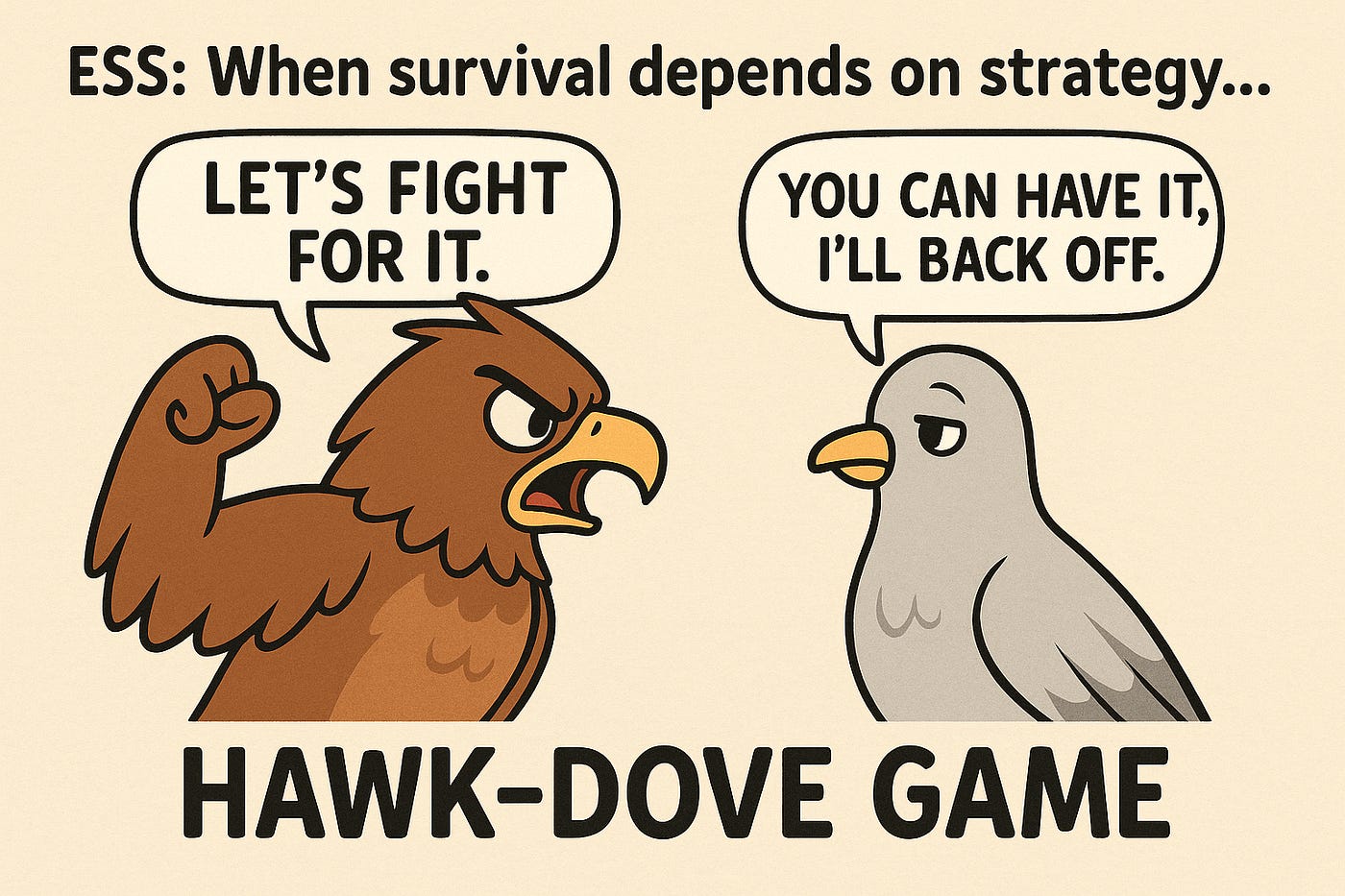
John Maynard Smith’s brilliant intuition was that evolution does not always favor aggression. Smith and Price created a game to illustrate this intuition, using the ESS. The game is called the Hawk-Dove game. It is an insightful way to illustrate the ESS and understand how it plays out in practice.
Think of individuals belonging to the same species. They compete for the same resources — whether it be food, territory or opportunities to breed. Given this endless competition for resources, individuals can adopt different strategies. In the Hawk-Dove game, individuals may adopt two strategies. The Hawk adopts an aggressive stance and fights for resources, while the Dove avoids physical confrontation and walks away from fights.
At first glance, several observations can be made:
Hawks:
Benefit: Hawks win the resource without a fight when they face a Dove.
Cost: when they face a Hawk, they will fight to get the resource, but run the risk of being severely injured.
Doves:
Benefit: Doves never sustain injuries, and when faced with another Dove, they settle the dispute with a peaceful staring match.
Cost: Doves always lose the resource when faced with Hawks.
Payoff Matrix
From these observations, we can build a payoff matrix, just like in the Prisoner’s Dilemma. It is important to note that the value of each payoff is arbitrary, and tweaking them may lead to dramatically different results.
We will use Dawkins’ version of the Hawk-Dove game. In the book, Dawkins gives a simple overview of the payoffs and doesn’t elaborate further, which serves his purpose beautifully. Here, I believe it is interesting to dissect the numbers, highlighting Dawkins’ elegant presentation of Smith and Price’s contribution to evolutionary biology.
Now, let’s construct a payoff matrix:
We suppose that on average, an individual wins half of even contests (Hawk vs Hawk and Dove vs Dove).
Winning the resource yields the individual 50 points (+50).
Dove vs Dove (E(D,D)):
When Doves face each other, they do not fight, but engage in peaceful contests such as staring matches, until an individual deems it a waste of time and walks off. Engaging in such contests costs each individual 10 points (-10).
Hawk vs Hawk (E(H,H)):
When Hawks face each other, the loser is seriously injured and loses 100 points (-100). The winner walks off with the resource: +50. It must be noted that in this simple example, we do not take into account the potential injuries sustained by the winner.
Hawk vs Dove (E(H,D) & E(D,H)):
When a Hawk meets a Dove, the Dove immediately walks away and gets no points (+0), while the Hawk wins the resource (+50).
Consequently, we get the following payoff matrix:
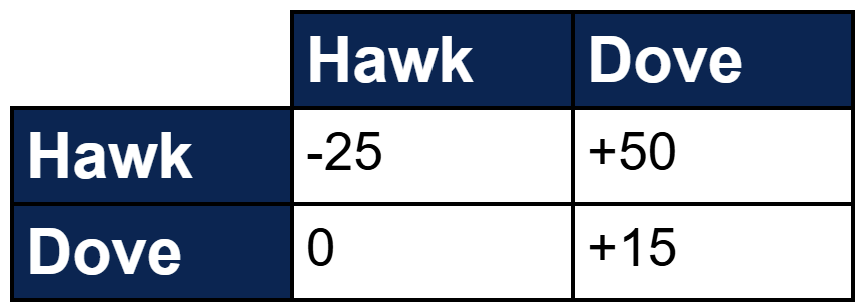
Is there an ESS consistent with this payoff matrix? In other words, is there a strategy evolving in the population such that an alternative strategy cannot invade?
Finding an ESS
All Hawks (pure strategy):
Suppose all individuals in a population follow the Hawk strategy. The average payoff for each individual is -25 (since E(H,H) = -25). Now, can this strategy be invaded by an alternative strategy, say, the Dove strategy? The payoff of a single Dove invading a population of Hawks is 0 (E(D,H) = 0). According to Smith and Price, these payoffs indicate that natural selection will favor Doves, as their chances of survival are higher, in a world dominated by Hawks. Thus, the conditions for an ESS are not met. It is evident that an all-Hawks population will inevitably be invaded by Doves.
All Doves (pure strategy):
Similarly, suppose that all individuals in a population follow the Dove strategy. The average payoff for each individual is +15 (since E(D,D) = 15). Now, can this strategy be invaded by an alternative strategy, say, the Hawk strategy? In a world of only Doves, the average payoff for a Hawk is 50 (E(H,D) = 50). It is easy to understand, since an individual who adopts an aggressive behavior always secures the resource. A population of all Doves is not an ESS because Hawks are bound to invade and be favored by natural selection due to their higher payoff.
A stable ratio of Hawks and Doves (mixed strategy):
Although populations of all Doves or all Hawks are not stable, it is possible to envision a ratio of Hawks and Doves that is stable, in such a way that a slight change in the ratio would be corrected by natural selection, bringing it back to the equilibrium. This ratio is reached when the expected payoff of the Dove strategy is equal to the expected payoff of the Hawk strategy.
Consider p the proportion of Hawks and 1-p the proportion of Doves.
E(H) = pE(H,H) + (1-p)E(H,D) = -25p + 50 -50p
E(H) = -75p + 50
E(D) = (1 — p)E(D,D) + pE(D,H) = 15–15p + 0
E(D) = -15p + 15
Let’s now solve E(H) = E(D):
E(H) = E(D) <=> -75p + 50 = -15p + 15 <=> -60p=-35 <=> p = 35/60
p = 7/12
1-p = 5/12
We know that p represents the proportion of Hawks. The stable ratio of Hawks and Doves under the above conditions is therefore 7/12 Hawks for 5/12 Doves. We found an ESS!
Natural selection will tend to favor individuals such that the overall population comprises 7/12 Hawks for 5/12 Doves. The implication is that the average payoff for Doves is equal to the average payoff for Hawks. Consequently, if a higher number of Hawks were to rise above the 7/12 proportion, the average expected payoff for a Dove in that new population mix would increase, and natural selection would tend to favor Doves over Hawks, until the stable ratio of 7/12 Hawks for 5/12 Doves is reached again.
Dawkins’ Masterful Use of the ESS Against Group Selection.
An ESS is stable, not because it is particularly good for the individuals participating in it, but simply because it is immune to treachery from within. — Richard Dawkins
As mentioned in the beginning of this article, some individuals display behavior that seems to benefit the species, as if there were some sort of cooperation working at the group level: this theory is called the group selection theory. Richard Dawkins thinks that our intuition is misleading, as natural selection operates at the level of the gene. In essence, it means that natural selection favors individuals whose genes are good at surviving and replicating themselves in the population through offspring. But how can this account for cooperation? What does the ESS have to do with Dawkins’ theory? Let’s come back to our Hawk vs Dove game.
If we follow the logic of group selection, we might expect natural selection to favor cooperation which would result in each individual benefiting from a higher expected payoff. According to group selection, in the Prisoner’s Dilemma, natural selection should favor cooperation at the group level, resulting in individuals obtaining the highest possible payoff.
In our Hawk-Dove game, based on the same matrix, we observe that in the ESS ratio of 7/12 Hawks for 5/12 Doves, the expected payoff for each individual is 6.25:
Remember that E(H) = E(D), meaning that for the ratio of 7/12 Hawks and 5/12 Doves, the average expected payoff for each individual is equal, regardless of whether they are a Hawk or a Dove. To calculate the expected payoff for each individual, we use the expected payoffs of Hawks. Please note that the proportion p of Hawks is 7/12.
E(H) = -75p + 50 = (-75 x 7)/12 + 50 = -525/12 + 50 = -43.75 + 50 = 6.25
Let’s now find the expected payoff for a population of only Doves. The result is 15.
The expected payoff for every individual in a population of 7/12 Hawks and 5/12 Doves is inferior to the expected payoff of individuals in a population of only Doves. Under group selection logic, natural selection should favor, at the group level, a conspiracy of only Doves. Yet, we now know that a population of only Doves is not an ESS. Consequently, we can infer that natural selection, in this case, does not work at the group level. According to Dawkins, the reason is very simple: natural selection works at the level of the gene, and in a population of only Doves, a single Hawk would have such an advantage that an all-Dove population cannot evolve: it is not an ESS.
It is now clear how the ESS is masterfully used by Dawkins to expose the limitations of group selection. However, his use of the ESS extends much further than the simple Hawk-Dove game: the ESS explains cooperation between species, within the family, the biological differences between males and females, and a significant number of fascinating behaviors having evolved in nature. In The Selfish Gene, these behaviors can primarily be explained by a selfish gene view of natural selection, reinforced by the elegant tool of the Evolutionarily Stable Strategy.
What About the Alarm Calls?
Dawkins writes:
“Bird alarm calls have been held up so many times as ‘awkward’ for the Darwinian theory that it has become a kind of sport to dream up explanations for them. As a result, we now have so many good explanations that it is hard to remember what all the fuss was about”.
The selfish gene theory claims that natural selection favors genes that are good at surviving in a population, generation after generation. The selfish gene theory must therefore demonstrate why alarm calls are beneficial for the survival of genes, even if at first glance, it looks like the bird’s behavior favors the group more than the individual bird (and therefore, its genes).
Here, we will briefly explore three main explanations that align with the selfish gene theory: kin selection, the ESS, and the “never break ranks” theory. Note that kin selection is widely discussed in Dawkins’ book, and that although it is vaguely related to group selection, it operates at the level of the gene.
Kin selection:
In a flock of birds, some individuals are closely related to each other: they have genes in common. Altruistic behavior is favored by natural selection because it gives higher survival chances — or chances of replicating themselves — to the genes present in different bodies.
John B. S. Haldane illustrated this by saying:
Would I lay down my life to save my brother? No, but I would to save two brothers or eight cousins.
In the case of alarm calls, one might assume that in the flock, a given individual has brothers, sisters, cousins for whom the benefit of saving outweighs the risk of emitting the call, from a selfish gene perspective, which is why it was favored by natural selection.
ESS:
With kin selection theory in mind, it is easy to imagine the existence of an ESS. In this example, the two strategies are giving a call, or staying silent. If the benefit to related individuals outweighs the cost to the caller, genes for alarm calls will spread in a population and the strategy of calling when a predator is spotted can become evolutionarily stable. While a silent mutant in a population of callers may arise, it may not succeed in invading because while it avoids the immediate cost, it does not contribute to the survival of shared genes in its relatives.
Never break ranks
In his book, Dawkins explains the “never break ranks” theory. Genes for calling may evolve in a population as a mechanism to never break ranks in the flock. A single bird, having spotted a predator, has the option to fly away. However, the latter strategy exposes it as a lone prey. Predators such as hawks are known to hunt birds who have separated from their flock. One can therefore conceive that natural selection would tend to favor genes for giving alarm calls, as staying in the flock and not breaking ranks gives higher prospects of survival.
Dawkins was right, there is no shortage of ways to explain bird alarm calls from a selfish gene perspective, without having to rely on group selection.
Conclusion:
John Maynard Smith and George R. Price have introduced a fascinating tool, the ESS, to understand how natural selection favors certain behaviors. Richard Dawkins masterfully uses it to explain the selfish gene theory and oppose group selection.
The point of this article was to introduce the ESS and Dawkins’ masterpiece of a book, The Selfish Gene. The selfish gene theory is a quite complex theory that encompasses many nuances. For the purpose of this article, some of these nuances have been overlooked, for the purpose of being — relatively — brief, and to encourage readers to explore the book.
In the book, Richard Dawkins uses the ESS and the selfish gene theory to explain behavior, relationships between generations and between sexes. Although it is a book about evolutionary biology, it gives insights into morality, philosophy, and helps us realize that nice guys can indeed finish first…
We have the power to defy the selfish genes of our birth and, if necessary, the selfish memes of our indoctrination. We can even discuss ways of deliberately cultivating and nurturing pure, disinterested altruism — something that has no place in nature, something that has never existed before in the whole history of the world. We are built as gene machines and cultured as meme machines, but we have the power to turn against our creators. We, alone on earth, can rebel against the tyranny of the selfish replicators. — Richard Dawkins in The Selfish Gene.
References
Dawkins, R. (2016). The selfish gene (40th anniversary ed.). Oxford University Press.
Wikipedia. (n.d.). Evolutionarily stable strategy. Retrieved from https://en.wikipedia.org/wiki/Evolutionarily_stable_strategy
Wikipedia. (n.d.). Prisoner’s dilemma. Retrieved from https://en.wikipedia.org/wiki/Prisoner%27s_dilemma
Further Details & Calculations
Evolutionarily Stable Strategy (ESS) — Definitions
Conditions for a strategy to qualify as an ESS:
Let’s look at the conditions for a strategy to qualify as an ESS:
Consider a strategy S and an alternative strategy T. The expected payoff for strategy S when playing against strategy T is represented by E(S,T).
1) E(S,S) > E(T,S)
or
2) E(S,S) = E(T,S) and E(S,T) > E(T,T)
In other words,
1) The expected payoff of strategy S playing against itself must be strictly greater than the expected payoff of strategy T playing against strategy S.
or
2) Alternatively, if the expected payoff of strategy S against itself is equal to that of strategy T against S, then for S to be an ESS, the expected payoff of S against T must be strictly greater than the expected payoff of T against itself.
Hawk-Dove Matrix:
Dove vs Dove (E(D,D)): 15
The payoff for the winner is +40 (50–10 = 40) while the payoff for the loser is -10. On average, the expected payoff of Dove against Dove is 15:
E(D,D) = (40–10) / 2 = 15 // we divide by 2 because an individual wins 50% of its contests.
Hawk vs Hawk (E(H,H)):
On average, the expected payoff of Hawk against Hawk is -25:
E(H,H) = (50–100) / 2 = -25 // we divide by 2 because an individual wins 50% of its contests.
Hawk vs Dove (E(H,D) & E(D,H)):
On average, the expected payoff of Hawk against Dove is +50:
E(H,D) = 50
On average, the expected payoff of Dove against Hawk is 0:
E(D,H) = 0
Finding an ESS
All Hawks (pure strategy):
1) E(S,S) > E(T,S)
or
2) E(S,S) = E(T,S) and E(S,T) > E(T,T)
Applying it to our example:
E(H,H) > E(D,H) => -25 > 0 // false
E(H,H) = E(D,H) => -25 ≠ 0
The conditions for an ESS are not met. There is no need for further calculations, as one can simply notice that an all Hawks population will inevitably be invaded by doves.
Game theory is interesting but you rightly point out that the values of the payoffs make the story. And those values are hard to come up with in many situations. the results contradict when the weights change so we have to have good weighs for the story to have any meaningful results. Do you know of any situations where the Hawk vs Dove game is studded enough to give actual results and therefore we can extrapolate the weights? that would be very interesting. cheers
The value of the risk of a hawk’s injury is too high. Not every aggressive encounter results in serious injury. In fact, few do.